Monday, April 28, 2014

Moderne Frau


My German professor calls me “Eine moderne Frau” during certain class activities. In fact, he just called me that in our last class. According to our limited vocabulary, I’m the epitome of a modern woman. We had been learning how to express our favorite activities. He’d ask “Kochen Sie?” to individuals in the class and they would reply either, “Ja, ich koche gern” (yes, I like to cook) or, “Nein, ich koche nicht gern” (no, I don’t like to cook). It just so happened that most of the girls in my class love to cook elaborate healthy dishes like soy-glazed salmon and sautéed vegetables with quinoa. So, it was a very stark contrast when I replied that no, I didn’t like to cook. At all. “Ah, eine moderne Frau!” exclaimed my professor.

William looks simultaneously shocked & terrified that I was attempting pancakes.

Having moved on to more complex expressions, this past class we learned more verbs to convey our abilities, talents, and obligations. I’m asked “Frau Kletscher, können Sie stricken?” Can I knit? My Grandma Doris, my dad’s mom once taught me….but can I knit now? I reply, “Nein, ich kann nicht stricken” and then I add “ich bin schlecht”. So no, I can’t knit, I’m bad at it. Once again my professor proclaims me “eine moderne Frau.”

Am I a modern woman because my personal preferences don’t align with certain gender stereotypes? Or is it simply because I haven’t needed the skills that are traditionally attributed to women? I’m thinking the answer is a combination of both.

Alice Splettstoeszer on the family's country kitchen.

On one level, looking back into the lives of my ancestors has brought me closer to them. On another, I see just how different my life is from theirs, which can be an interesting distancing experience. I grew up in a fairly large suburb. My parents’ graduating classes were smaller than any one of my class sizes and their entire town population could have attended my high school, with a capacity of 2500, in the same year. We buy everything from the grocery store, except for maybe fresh fruit from the citrus trees in our yard. Though there are small fields of alfalfa and cotton on the Native American reservation less than 10 minutes from my house, I never grew up or worked on a farm. Most of my grandparents had grown up on farms before they moved into the center of the towns they raised their families in. But I grew up in Scottsdale nearly 50 years later. I don’t need to know how to knit or cook and have had to learn other things like computer skills.

Funny article immortalized in the Splettsctoeszer Family Cookbook.

Throughout my project, I’ve tried picturing myself living alongside my ancestors. As noted, it’s an often distancing experience. It’s hard to imagine my lifestyle on a farm: I stay out late attending or working events, then sleep in on the weekend. I cook only out of necessity and prepare simple dishes like pasta, couscous, and sandwiches—then immediately pop my dishes into the dishwasher—or else I order late night takeout with friends.  I do like to live in a clean apartment but when I’m cleaning, I’m usually also procrastinating about schoolwork. I love to do laundry…but these days, who wouldn’t when all you have to do is start the machines and later fold your fresh, warm clothes?

Visiting our family friends' farm.
Stan Ehrke showing us a baby chick.
At the Ehrke's farm.
William & Dad feeding a horse.

I’ve also never really done well with livestock. I love animals but from afar, unless there are dogs around. I’ll always remember when our family friend practically forced me to ride the small, smelly pony at our harvest festival in elementary school. I’ve become more accepting of horses since then, riding on scenic trails in the desert or on a day trip to a hidden waterfall in the Dominican Republic. But I would never own one, or any other kind of common farm animal. I know from experience that I simply couldn’t. In second grade, my school went to Dugan’s Dairy Farm, a milk provider for Shamrock Farms. I don’t have fond memories of the place, and the pictures in my class scrapbook prove it.

Things started out well.
We're shown the tubes of the milking machines.
I clearly can't take the smell of the cows behind my friend, Palmer, & I.

My face of disgust after being coerced to try milking a cow. 
I do have a friend who is interested in agriculture. She wants to own a farm one day in—you guessed it—Minnesota. She loves raising animals and even had a club devoted to raising cattle for competitions during her undergraduate years, when she also majored in agricultural studies. I think there is something modern in that, in using her formal education and global travels to live as a farmer or rancher in today’s world. I wonder what my professor would think of my friend. While I take his “moderne Frau” label lightly and I’m certain he means well, I still feel it is an interesting, almost old-fashioned, reflection of his views; especially in a college classroom in Los Angeles in 2014. I have grown up in a generation where I have the time and means to pursue skills like knitting, cooking, gardening, etc. at my leisure. My life doesn’t depend on them. That is what modern means to me; having choices and the freedom to pick the lifestyle I desire. 

Thursday, April 24, 2014

Review: Disappearance: A Map


“What she left us is a gossamer:  a life reflected, and caught; on the wing of a dragonfly.”

Sheila Nickerson admired the mysterious Lady Sarashina for her ability to capture the world around her as well as her individual perspective of Japanese court life. I admire Nickerson’s writing for the same reasons. In addition to mysterious Alaskan expedition history and Alaskan life, Disappearance encompasses Nickerson’s own daily events and thought processes. Through these minor personal accounts, the reader is drawn into the unsettling mysteries of disappearance and the unknown.

Writing is first and foremost a catharsis for Nickerson. Though she repeats this fact on several occasions, it is evident from her intrapersonal approach as she discloses her fears and asks big life questions. Nickerson wrestles with the next stage in her life, retirement, ultimately reexamining her life up until this moment. Her book runs on the clichéd metaphor that life is a journey and the body is a map of all experiences. But Nickerson’s sincerity in her soul search and her seemingly intimate prose keeps the book grounded. Her mastery maintains a safe and relatable balance between warm recollections and melancholic feelings felt in her transition. These alternately match in intensity and give the reader breaks from the spookier and sublime ideas expressed in her fears of being forgotten and previous disappearances in the Alaskan wild.

Significant portions of each chapter contain historical accounts of lost, failed, rescued, etc. expeditions to and through Alaska. As interesting as they are, I found myself wondering how such ill-fated attempts could help Nickerson understand herself in a better capacity. The subject of disappearance simply seemed to be the focus of a somewhat morbid obsession, like an interest in the Bermuda Triangle. But as history continued to unfold, Nickerson brought more disappearances to light; those of close friends, other Alaskans, native languages and culture, wildlife, etc. They are examples of her worst nightmare. Just two decades ago, she was finding connections to hundred-year-old explorations and ensuing disappearances. But I continued to find parallels in my own reading, especially as the story of Malaysian Flight 370 was slowly unfolding. The book is partly a tribute to what has been lost and/or unable to stand the test of time as well as Nickerson’s own protection against the same fate.

Numbered “records” punctuate chapters. Each is dated, followed by specific coordinates, and a very brief story of what happened on that day. It wasn’t until later in the book that I realized these records were Nickerson’s expedition notes left in her own kind of cairn—a book. She often mentions “coordinates that hold us in place”. Her records, simple and factual, are her protection against being forgotten; as if we would find evidence of Nickerson’s life or feel more connected to her journey were we to stand at these exact latitudes and longitudes.

I, too, share an odd fascination with the unexplained, mysterious disappearances, and haunting loss. I kept returning to my childhood when I was drawn to any book I could find on Roanoke, the Titanic or the Bermuda Triangle. Nickerson’s extensive research into the Alaskan expeditions was thought provoking. I was constantly torn between understanding the stories as the tragic consequences of hubris or the human desire to make a mark in the world as Nickerson explores. With her lyrical and evocative prose, I was entranced not only by her writing but her use of it to tackle a profound soul search. I felt her words spoke to my own life transition—coming into my own now that I am graduating from college. Whereas Nickerson related her own life journey and map to other Alaskans, I have sought to see my own journey and resulting map in relation to my family and ancestors.

I have never read anything quite like Disappearance, which blended history and landscape with such personal revelations. Eat, Pray, Love comes to mind, but the sincerity of Nickerson’s questions and almost “suffering in silence” persona overshadow Gilbert’s excessive whine. If you are looking for a more stimulating and transformative account, or are in the middle of a important transition yourself, I highly recommend Disappearance.

Wednesday, April 16, 2014

Things I Do When I Have Things To Do


Make to-do lists
Check emails
Organize my side of the room
Complain
Make tea or coffee
Scroll Pinterest
Get a snack
Actually Log on to Facebook
Journal
Clean the bathroom
Watch Jeopardy
Start the to-do list

Things That Make Me Cry


Stress
Nostalgia
Perfect moments
Tragic love stories
“You jump, I jump, remember?”
Favorite characters dying
Funerals
Series finales (Books & on the screen)
Meaningful compliments
Unexpectedly rude comments
Soldiers coming home
Inspiring interviews, films, videos
Wedding proposals
Wedding montages
Specific songs
Onions

Tuesday, April 15, 2014

42 Maple Street


Before Grandma K moved into her cozy apartment, she lived in this big blue house on Maple Street. It looked so welcoming with its wrap-around porch. When we’d visit, we would have to squeeze between the piles of magazines and old memorabilia to sit on her comfy chairs. She was a bit of a pack rat, but in a cool way that always meant you’d see something interesting, like a pair of wooden Dutch shoes that happened to be sitting in the doorway of the bedroom upstairs. The guys on American Pickers would have loved the sentimental hodgepodge and Grandma K, for she was one special lady with a lot of moxie.

You always knew Great-Grandma K had just arrived because you could hear the adults talking that she hadn’t called before heading over. “She shouldn’t be driving anymore, especially in the rain.” But there Grandma K would be in the driveway; stepping out of her teal sedan with a plastic kerchief tied around her head to protect her freshly colored white-blonde curls from the weather. As soon as the adults finished fretting and scolding, she would usually turn to the nearest great-grandchild and confide “what a bunch of turds” with a laugh.

After she passed away, my Aunt Kristi sent a box of things Grandma K had left for my mom. But there were other interesting trinkets in the box representative of Grandma K that my aunt had chosen as remembrances. For instance, she sent my brother a small porcelain cat the size of a silver dollar. Its belly was flat and had “Gum Parker” painted on it, just in case he ever needed a temporary place for his chewing gum.

But the items within the blue house weren’t its only attractive quirks. Right off the kitchen was a door that led down to the cellar. One of my older cousins, Breanna, used to scare her sister and I with descriptions of what it looked like down there. She made it out as the creepiest place in town. According to her, the cellar had walls and shelves carved right into the dirt beneath the house. The shelves were also covered in cobwebs and you had to watch out for spiders since it was so dark down there. It doesn’t sound as scary any more, perhaps she was telling the truth. There was something oddly exciting about having that spooky door always waiting for us to open it and peer into the darkness. Either way, the descriptions scared Mackenzie and I so much so that we didn’t dare go down into the cellar that summer. 

Grandma Joyce labeled this with:
 "Karina, the barmaid at Grandma K's, 2000"

Then there was the outhouse in the backyard. It was unused, of course, and had been for quite some time. The outhouse was a funny relic of the past, which for some reason was curiously alluring to all of us great-grandchildren. When we’d all open the wooden door and look in, we’d see the small bench with the boarded up hole. Grandma K had still kept a stack of outdated magazines inside of it as a joke; one day someone might need reading material when they are out there.

This was the lady who let my Mom and Aunt Kristi run unaccompanied at a very young age down the alley behind her house to Schubert’s, the local grocery store. After slipping them some extra coins from her top drawer for more sweets, Grandma K would hop on the party line to let her sister Edna Schubert know the little girls were on their way. Edna indulged them like her sister did; she would greet my Mom and aunt, allow them to fill up a paper bag with candy and would then slip the girls more than they had coins for. After sending them back down the alley, Edna would let Grandma K know they were back on their way via the same party line.

Though Schubert’s was no longer around when my siblings, cousins, and I were little, Grandma K always had snacks around for us. I always remember small bowls of nuts and candy she would leave out while we were playing games with her. In between turns of Old Maid, you could find a treat at arm’s length in a leaf-patterned crystal dish without even looking. You always wanted to be watching your game too, because though Grandma K loved to play, she was always too excited to maintain a poker face. As soon as she found the Old Maid card in her hand, she’d let out a little groan. When you were picking from her hand, the smile on her face desiring you to take it off of her would signal which card was actually safe to take.

Grandma K and Mom playing Old Maid.
Grandma K's new apartment.


Playing cards on another visit in the summer.
Note the shared moment between Grandma K & Maren,
 who both know Grandma K has the Old Maid card.

Other games were easier for Grandma K to win because her enthusiasm wouldn’t risk her success. One winter, she taught my sister and I to play dice. You should have seen her excitement when my Grandpa Larry suggested we raise the stakes and gamble for candy. Each time the dice spilled from the cup, Grandma K would react appropriately with a disappointed “oh no!” or a celebratory hoot. Games always turned into a vocal affair when she, Grandpa Larry, and Maren were all playing. They were so invested in the play that the entire suspense of the game seemed to come from their own enthusiasm.

Learning dice at the blue house.


Behind its lace curtains, 42 Maple Street had an air of magic and mystery. Chewing on the chocolate cigars Grandma K kept around for all her great-grandchildren, I would sit staring and wondering at everything within the house. Why were these little stuffed animals or those wooden shoes here? How did they get there? Was there more past that spooky cellar door?  And why did this old house always feel so full? Sitting and wondering more than 10 years later, I realize that in the center of it all, between all of the visiting family and nostalgic belongings, was Grandma K radiating her spunky joyful spirit that filled any empty place in her home.

Friday, April 11, 2014

Souvenirs Collected Over the Years by a Native Minnesotan


Log Chute Pictures in Camp Snoopy Frames
Minnesota Passport
Pooping Cow Keychain
Minnesota Twins Sweatshirt
Vikings Slipper Socks
Mosquito Socks
Mosquito Trap
Oversize Paul Bunyan Land Postcard
Paul Bunyan Land Collectible Plate
Paul Bunyan Land Statuette
The Grinch Coin Purse from Macy’s 8th Floor Holiday Display
T-Shirt: 10 Commandments Minnesota Style
1.     Der’s only one God, ya know.
2.     Don’t make that fish on your mantle an idol.
3.     Cussin’ ain’t Minnesota nice.
4.     Go to church even when you’re up nort.
5.     Honor your folks.
6.     Don’t kill. Catch and release.
7.     There is only one Lena for every Ole. No cheatin’.
8.     If it ain’t your Lutefisk, don’t take it.
9.     Don’t be braggin’ about how much snow ya shoveled.
10. Keep your mind off your neighbor’s hotdish.
Pooping Moose Keychains
Lake Como Keychain
Tiny Cardinal Made of Bark
Twin Cities Monopoly
Life on a Farm Boardgame
Books:
             You Know You’re a Minnesotan If…
            Minnesota Shapes
How To Talk Minnesotan: A Visitor’s Guide
Critters of Minnesota Pocket Guide
You Know You Are a Lutheran If…
Ghostly Tales of Minnesota
History of the Golden Gophers
Minnesota: Memories & Images
A Rewind on the Minnesota Music Scene
A History of Minnesota Sports
University of Minnesota Shirt
St. Cloud State Shirt
Lester Prairie Bulldogs Baseball Hat
Lester Prairie Public School Commemorative Mug
Lester Prairie Centennial Commemorative Mug
Jar from Itasca State Park (Headwaters of the Mississippi River)
Beer Stein from Bayrischer Hof Restaurant
Schmidt Beer Pitcher from Danke Schoen Tagen in Mayer, MN

Wednesday, April 9, 2014

Gone Fishing


There is something so satisfying in the smell of fish sizzling on the griddle. It always meant a delicious home cooked meal from someone’s catch that day was about to be served. Once the fresh fish had been cleaned and cut, it was then dredged in the flour mixture. As soon as it was placed on the hot griddle, the fish would set off a loud hiss. That sound would always bring everyone closer to the kitchen from where the mouthwatering smell wafted.

Grandma Joyce frying the day's catch.

Growing up, fishing had been the boys’ thing. My two cousins, Adam and Jacob, Uncle Bruce, and Grandpa Larry would all head out in the morning in the truck towing the fishing boat behind them. In the afternoon, they would return from a day out on the lake with a cooler full of fish. Part of me always wanted to tag along, but I didn’t think I’d be any good at fishing. Even at that age, I knew that feeding your pioneer family in the Oregon Trail computer game was completely different from the real thing.

One day, my curiosity urged me to follow my uncle and the big cooler of fish around to the back of my grandparents’ house. My cousin, Mackenzie, and I watched as he cleaned and cut up each of the fish they had caught. I had come too close, though, and blood spurted down the front of my clothing; my new white shirt with Esmeralda on it from Disney’s The Hunchback of Notre Dame was eventually ruined as the blood and fish oil stained it. I was really bummed but had at least been able to satisfy my curiosity.

Years later, I finally learned how to fish and experienced the fulfillment of a meal produced from what I had caught.

It was a warm breezy morning the day we headed out to the lake for a simple fishing lesson. I helped hitch up the boat and drove in the truck with my Grandpa as my Grandma, Mom, and little brother, William, followed behind in their van. I remember that drive as one of the most picturesque drives I had ever been on in Minnesota. It sounds so cliché, but the sun was truly shining in the clear, light blue sky, illuminating the green fields and woods. I experimented with my first digital camera that I had received for Christmas, desperately trying to capture the perfect moments we passed on the country roads. Subtly rolling hills of green crops. The sun glinting off the tall, vibrant stalks. Dust swirling in the middle of the dirt road from the previous truck. Barns in all shades of well-worn red.


Grandpa Larry and I backed the boat into the water from the boat landing dock and met the others around the other side of the lake. We picked them up and sped off to a quiet spot where we might fish undisturbed.

Caught in the stinging mist from speeding across the water.

I had never seen fishing poles so short until my Grandpa pulled out several from the boat’s storage. But they got the job done. We used mealworms to bait the small sunfish and then waited for them to bite. I want to say we were really good, but I think the sunfish were just plentiful that day.

William and Grandma Joyce with their flopping catch.
My Grandpa Larry and I very excited over my first catch.

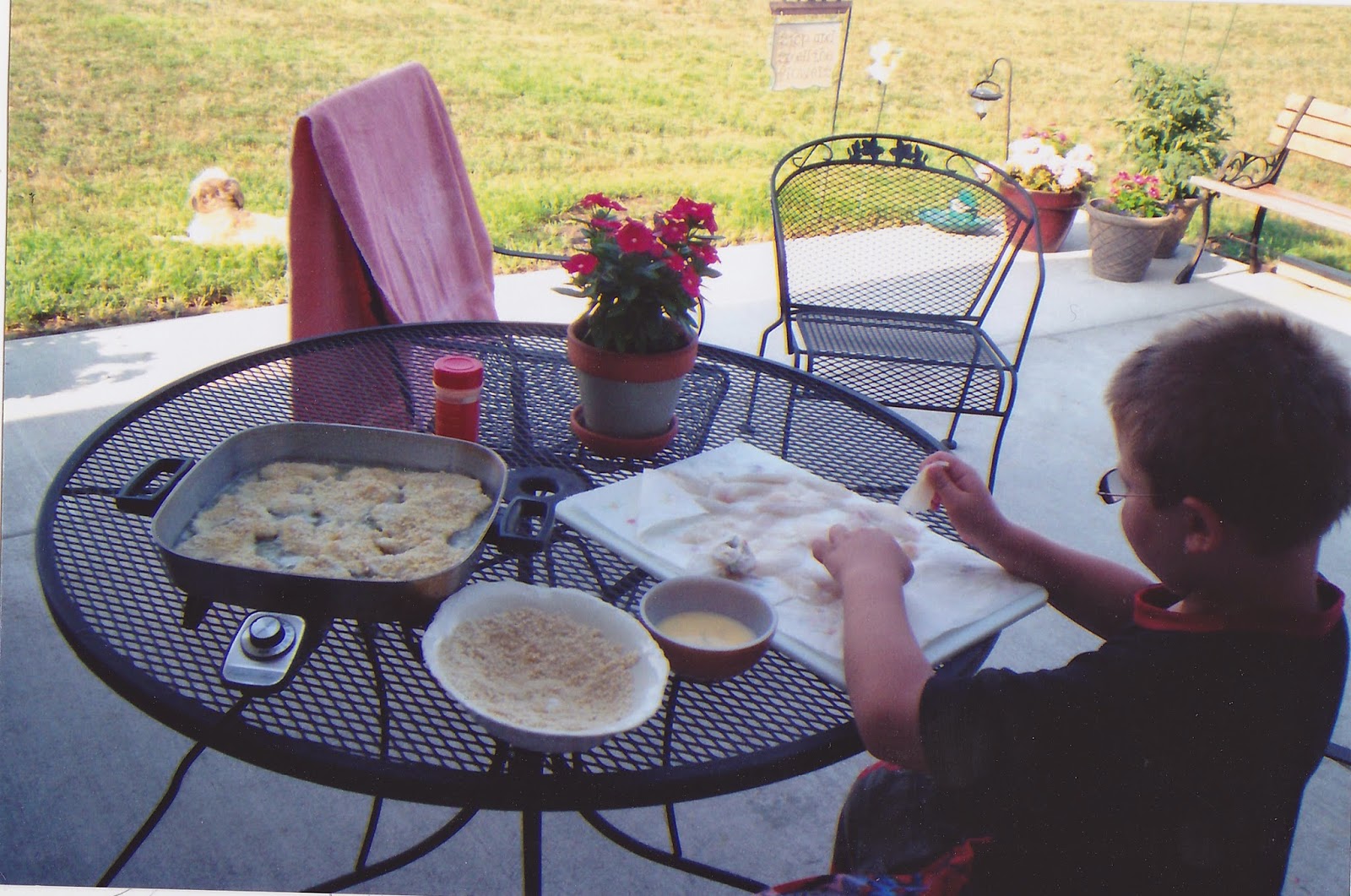
We headed home in the late afternoon with our bountiful catch back down the scenic country roads. Each of us took turns cleaning up from the day spent on the lake. By the time we were all done, my grandparents had the sunfish cleaned and cut, ready to be cooked. William, ever the eager assistant in the kitchen, helped Grandma Joyce dip the cuts into the egg mixture then dredge them in the flour.


My dad, Bruce, watching William prepare the fish.
Soon, the griddle was sizzling with the breaded fish and that wonderful smell wafted back through the screen door into the townhouse. Even those of us who weren’t cooking had gathered in the kitchen, our mouths watering, awaiting the delicious meal and recounts of the day we were about to share.